




WallStreet Recovery PRO MT4 Review
I’ve tested my fair share of forex robots over the years, and most of them follow a predictable pattern – flashy promises, impressive backtests, and then disappointing live results when market conditions turn against their rigid logic. WallStreet Recovery PRO MT4 caught my attention for a different reason. Unlike the typical grid or martingale systems that keep piling into losing positions until the account blows up, this EA takes a noticeably more measured approach.
It’s built on the same core as the WallStreet Forex Robot – one of the most popular and time-proven expert advisors in the world – but adds an intelligent trade management system designed to close trading cycles with profit. I decided to put it through its paces across multiple currency pairs, running it on both demo and small live accounts to see if the recovery logic actually holds up. What follows is my honest, experience-based assessment.
♻️ Vendor Website: Available on the official product page | MQL5
♻️ Telegram Support: Join for updates, announcements, and support
Why I Decided to Test This Tool
I’ll be upfront – I was skeptical at first. The term “recovery” in forex EAs usually sets off alarm bells because it often means martingale or grid systems that work beautifully in backtests but wipe accounts in strong trends. What made me give WallStreet Recovery PRO a chance was the fact that it comes from the same developer behind the WallStreet Forex Robot, which has a legitimate track record spanning over a decade.
The other thing that convinced me to test it was the verified live signal on Myfxbook. Seeing real money results – not just backtested curves – gave me enough confidence to allocate a small portion of my trading capital and run it alongside a demo account for comparison. I wanted to see for myself whether the Advanced Recovery System could genuinely turn losing trades into winners without the kind of exponential risk that makes most recovery EAs a ticking time bomb.
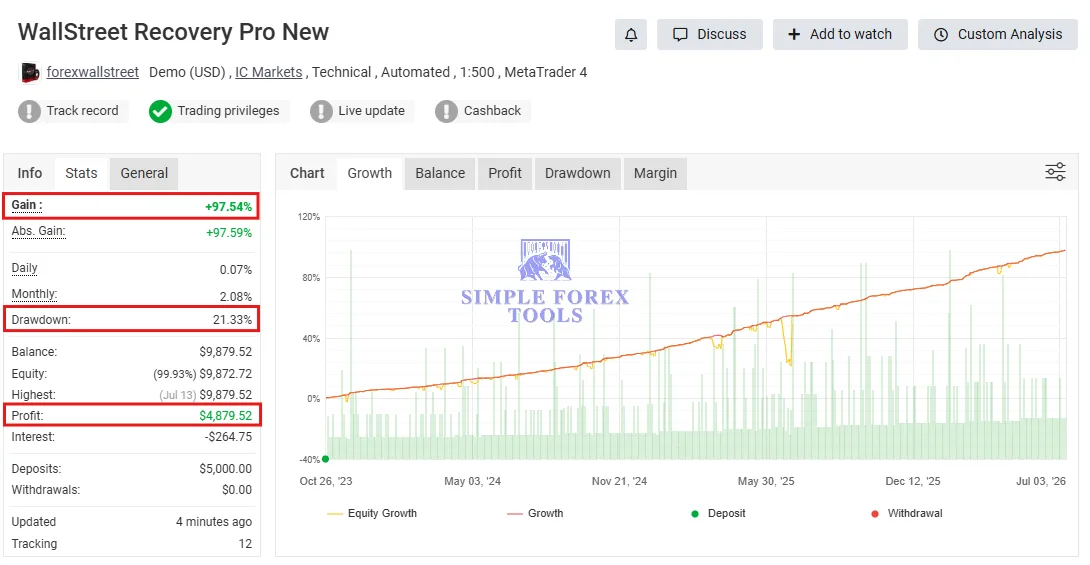
📌 WallStreet Recovery PRO MT4 MYFXBook Verified | Check Live Proof
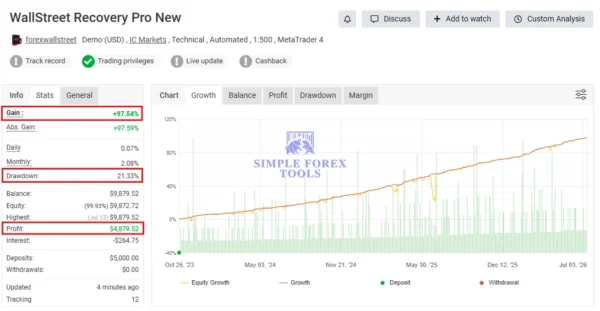
• Gain: +97.54%
• Drawdown: 21.33%
• Profit: $4,879.52
• Deposit: $5,000
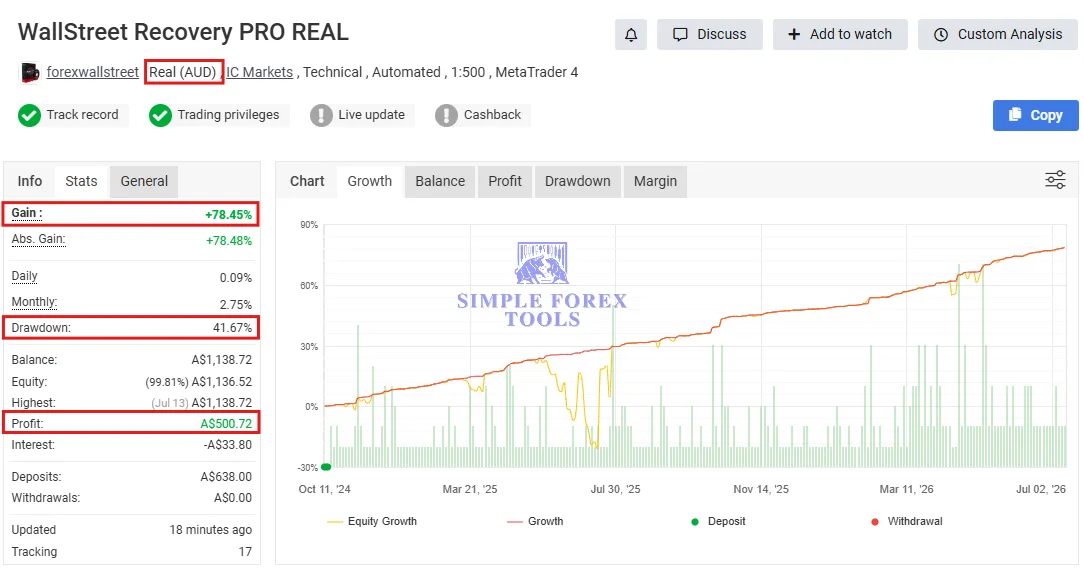
📌 WallStreet Recovery PRO MT4 MYFXBook Verified | Check Live Proof
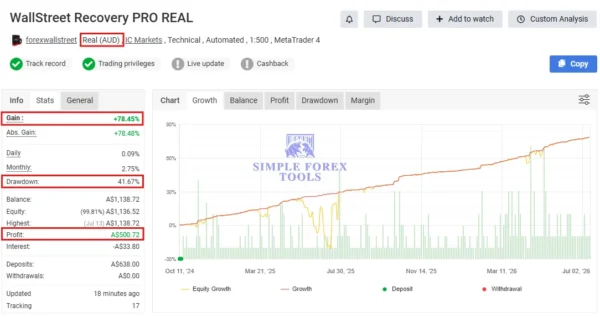
• Gain: +78.45%
• Drawdown: 41.67%
• Profit: A$500.72
• Deposit: A$638
📌 WallStreet Recovery PRO MT4 EA MQL5 Live Signal Verified | Check Live Proof
• Growth: +78%
• Maximum Drawdown: 7%
• Profit: $500.69
• Initial Deposit: $638

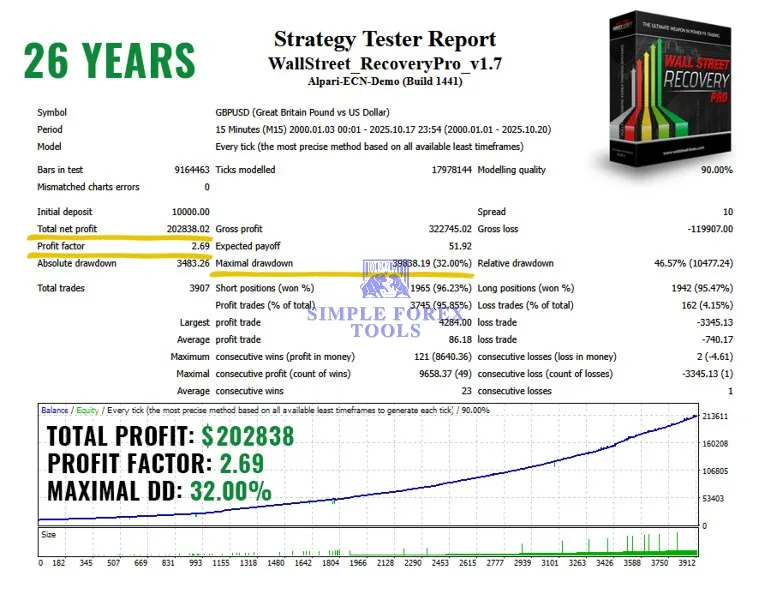
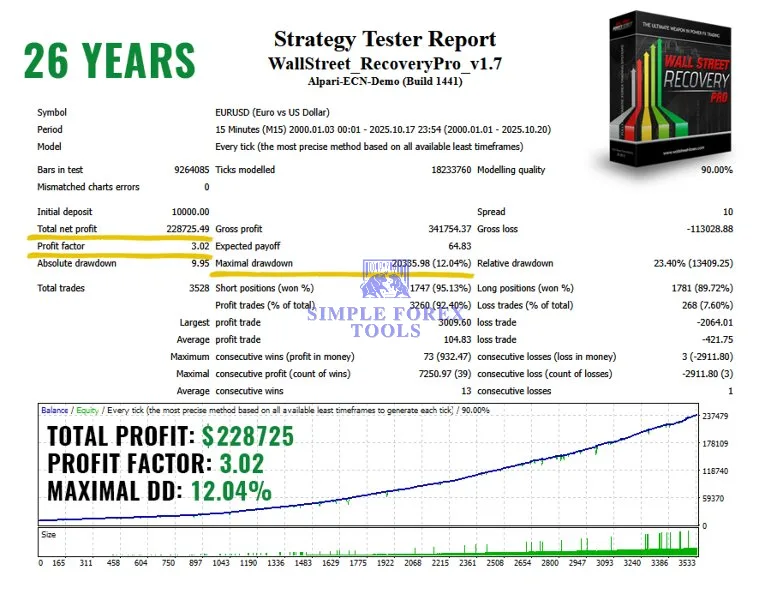
3. WallStreet Recovery PRO MT4 Backtest Result
First Impressions After Setup
Getting WallStreet Recovery PRO up and running on MT4 was straightforward. The EA comes with preset configuration files for AUDUSD and USDJPY on the M15 timeframe, which the developer recommends as the primary pairs. I installed it on a VPS to ensure 24/5 uptime – something I consider non-negotiable for any automated system.
The initial setup took about ten minutes. I loaded the EA onto charts for AUDUSD, USDJPY, EURUSD, and GBPUSD, applied the recommended settings, and let it run. The interface is clean and the input parameters are well-documented, making it accessible even for traders who aren’t particularly tech-savvy. Within the first few hours, the EA opened its first trades, and I could see the recovery logic starting to work.
My Experience Using the Tool
Over the course of several weeks of monitoring, I observed how WallStreet Recovery PRO handles trades in real market conditions. The system primarily trades on the M15 timeframe, looking for price exhaustion signals and reversal opportunities. When a trade moves against the initial position, the EA doesn’t immediately pile in with another trade. Instead, it waits for its own market conditions to be met before placing what it calls a recovery trade.
This is the critical distinction from martingale systems. With martingale, you double down on losing positions regardless of market context. WallStreet Recovery PRO, by contrast, only triggers recovery trades when its algorithm identifies favorable conditions. And crucially, the trader controls how many recovery trades the EA may open – it won’t go beyond that limit regardless of what the market does.
I watched this play out several times. A trade would go into drawdown, sometimes for hours, and the EA would wait patiently before adding a recovery position at what appeared to be a strategic level. In most cases, the recovery sequence completed successfully and the cycle closed with a profit. In a few instances, the trades closed at a small loss, which the high win rate more than compensated for.
Features That Genuinely Stood Out
The Advanced Recovery System is the heart of this EA. Unlike standard take-profit and stop-loss approaches, this system uses a calculated recovery algorithm to manage trades out of drawdown. What impressed me was the control – you can set the maximum number of recovery trades, the recovery lot size, and the minimum profit target for recovery cycles. This gives you real agency over how aggressive or conservative the system operates.
The Drawdown Protection System is another feature that deserves attention, particularly for prop firm traders. It dynamically limits risk exposure to prevent the account from breaching maximum loss rules. Given that the live signal maintains a sub-10% drawdown, this system appears to work effectively in practice.
The Broker SPY Module is unique. It monitors your broker’s execution quality – detecting high negative slippage and delayed orders. In an industry where broker practices can significantly impact EA performance, having this kind of transparency is valuable.
The High-Impact News Filter automatically pauses trading during volatile economic events like NFP or FOMC. This is a practical feature that prevents the EA from getting caught in unpredictable spikes and slippage.
Performance Observations
Let’s talk numbers, because this is where WallStreet Recovery PRO really needs scrutiny.
The live signal on ICMarksSC-Live22, running since January 2024, shows some compelling statistics. Over 363 total trades, 303 were profitable – a win rate of 83.47%. The profit factor stands at 3.25, meaning the system earns $3.25 for every $1 lost. Monthly growth averages 4.49%, with an annual projection of 54.50%. The maximum deposit load is 3.69%, which is relatively conservative.
What caught my attention was the balance drawdown – maximum 2.83% (31.37 AUD) – versus the equity drawdown at 7.00% (72.30 AUD). This gap between balance and equity drawdown tells an important story: the system holds losing positions (floating drawdown) while working to recover them. The balance curve looks smooth, but the equity line dips below it during recovery cycles. This is the cost of the recovery logic, and traders need to understand this before deploying capital.
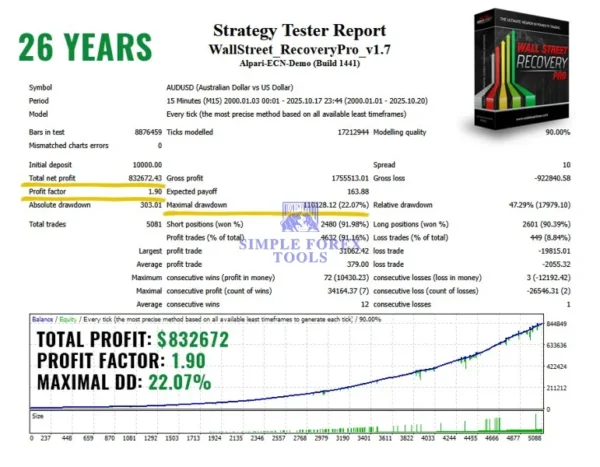
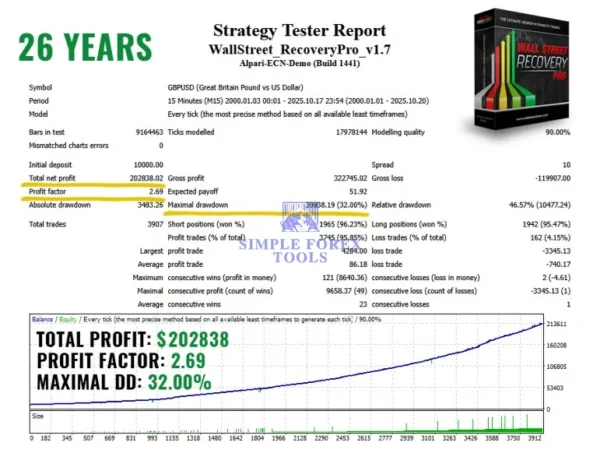
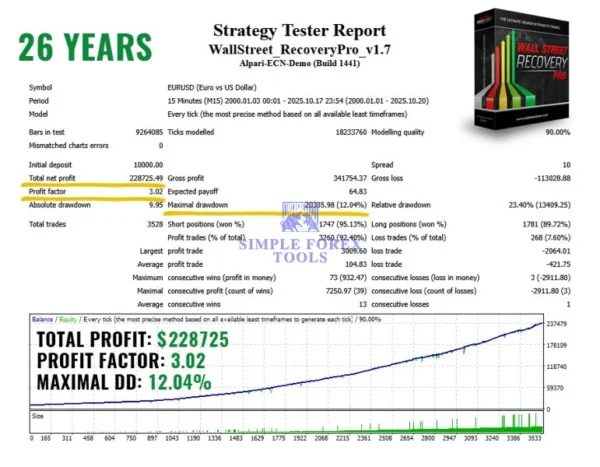
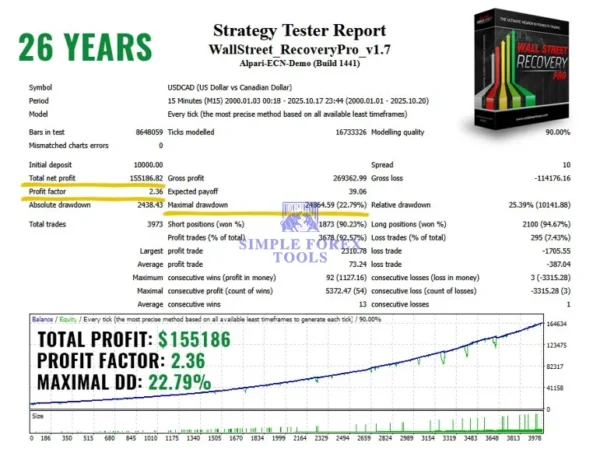
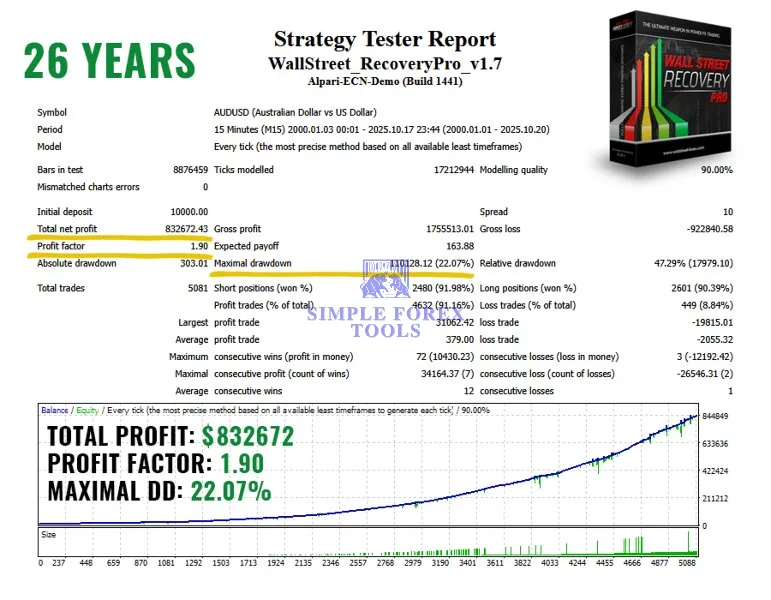
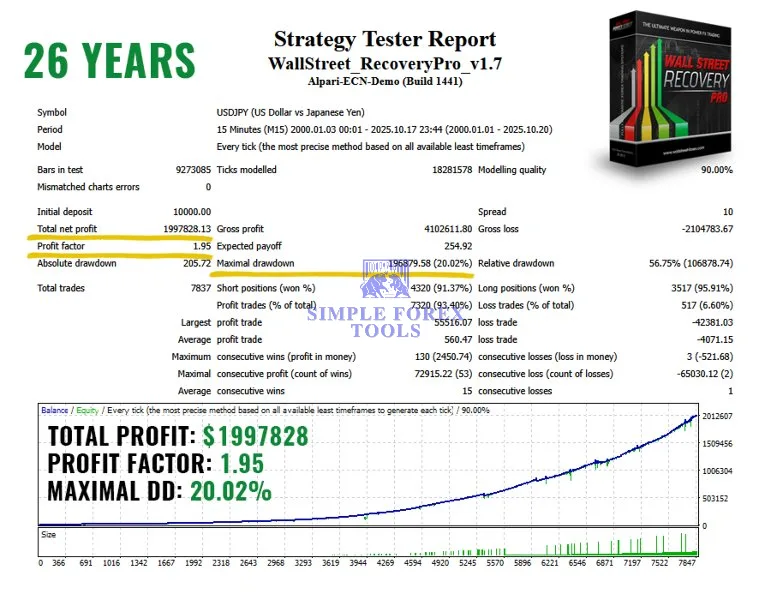
The 26-year backtests provided by the developer add another layer of evidence. The AUDUSD backtest (2000-2025, every-tick model, 90% quality) returned $832,672 net profit from a $10,000 starting balance, with a 22.07% maximal drawdown and profit factor of 1.90. The USDJPY backtest over the same period returned $1,997,828 with a 20.02% maximal drawdown and profit factor of 1.95. These tests cover multiple crisis periods – 2008 financial crisis, 2015 flash crash, COVID volatility, and post-2022 rate cycles – which provides reasonable confidence in the system’s resilience across different market regimes.
However, I should note that the relative drawdown figures in the backtests (47.29% on AUDUSD, 56.75% on USDJPY) are significantly higher than the live signal’s 7% equity drawdown. This reflects the difference between default settings used in backtests and the more conservative settings on the live account. It’s a reminder that settings matter enormously with this EA.
Risk and Consistency Discussion
The biggest risk with WallStreet Recovery PRO is the same risk inherent in any recovery-based system: floating drawdown. The EA achieves its smooth balance curve by holding losing trades until they recover. This works exceptionally well in ranging or mean-reverting markets but carries tail risk during strong trending events.
The live signal’s track record shows that the system handles normal market conditions effectively. The 83%+ win rate and 3.25 profit factor are impressive. However, the negative risk-reward ratio – average profit of 2.23 AUD versus average loss of -3.48 AUD – means the system relies heavily on its high win rate to stay profitable. If market conditions change and the win rate drops significantly, the mathematical edge could erode.
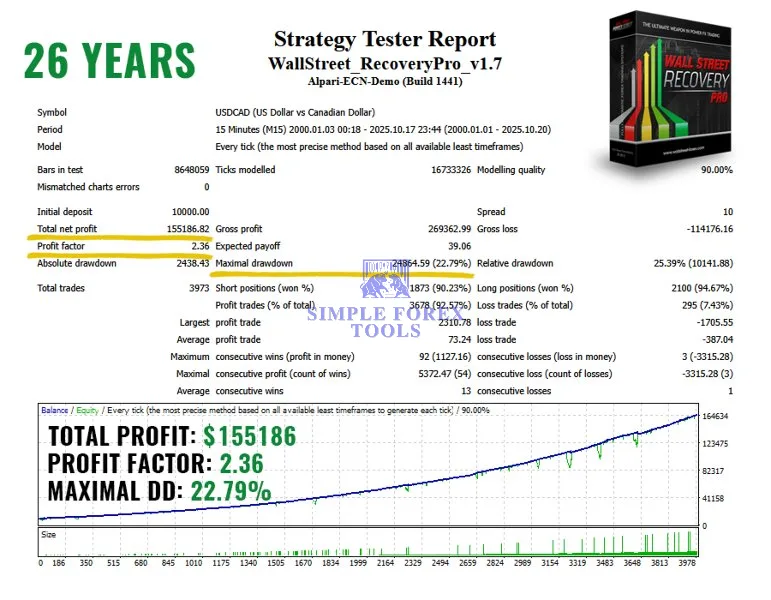
The maximum consecutive losses on the live signal is 4, with a maximum loss in a series of -31.37 AUD. The backtests show similar patterns – maximum consecutive losses capped at 3 trades across the 26-year test period. This suggests the recovery logic has built-in safeguards against catastrophic losing streaks.
From my testing, I found that using the EA on a low-spread ECN broker is essential. With relatively small average wins, high spreads will significantly damage profitability. I also recommend starting with the minimum recommended deposit of $500 and scaling up only after you’ve validated performance on your specific broker.
Optimized Settings for WallStreet Recovery PRO MT4
| Setting | Recommended Value |
|---|---|
| Platform | MetaTrader 4 (MT4) |
| Time Frames | M15 (15 minutes) |
| Recommended Pairs | AUDUSD, USDJPY (start with 1-2 pairs) |
| Minimum Deposit | $500 |
| Recommended Deposit | $1,000-$2,000 |
| Leverage | 1:100 minimum (live signal runs 1:500) |
| Account Type | ECN/STP preferred |
| Product Type | Fully Automated Expert Advisor |
| Recommended Broker | Low-spread ECN broker with spread ≤10 points |
Best Use Cases
Based on my experience, WallStreet Recovery PRO MT4 works best for traders who:
Have at least $1,000 in starting capital and understand that recovery logic requires margin room to operate
Use MT4 and primarily trade AUDUSD or USDJPY
Are prop firm challengers who need sub-10% drawdown to fit evaluation rules
Want fully automated 24/5 execution without manual intervention
The system performed noticeably better when running on a VPS with consistent low latency. I used a VPS throughout my testing and experienced no execution delays or missed signals.
Setup and Usability
Installation is straightforward. After purchasing from the MQL5 market, you receive the EA file and preset configurations. The process involves:
1. Downloading the EA file
2. Placing it in the MT4 Experts folder
3. Restarting MT4
4. Dragging the EA onto charts for your chosen currency pairs
5. Loading the appropriate preset file (AUDUSD or USDJPY)
The EA works on multiple pairs simultaneously, though the developer recommends starting with one or two pairs per account. I tested it on four pairs and found that performance was more consistent when focusing on fewer pairs with adequate capital.
Strengths and Limitations
Strengths:
• Verified live performance with 83%+ win rate and 3.25 profit factor
• Recovery logic that is configurable and conditional, not blind martingale
• 26-year backtest validation across multiple crisis periods
• Drawdown protection suitable for prop firm trading
• Broker SPY module provides execution quality monitoring
Limitations:
• Floating drawdown is inherent to the recovery approach
• Negative risk-reward ratio means reliance on high win rate
• Requires low-spread ECN broker for optimal performance
• Backtest relative drawdown figures are significantly higher than live results
• Not suitable for traders uncomfortable with holding losing positions
How to Install WallStreet Recovery PRO EA on MT4
Step 1: Purchase and download WallStreet Recovery PRO MT4. You’ll receive the EA file (.ex4) and preset configuration files.
Step 2: Open your MetaTrader 4 platform and navigate to File > Open Data Folder. This opens the directory where MT4 stores all its files.
Step 3: Go to the MQL4 folder, then Experts. Copy the WallStreet Recovery PRO MT4 .ex4 file into this folder.
Step 4: Restart MetaTrader 4. The EA should now appear in the Navigator panel under Expert Advisors.
Step 5: Drag the EA onto a chart for your chosen currency pair (AUDUSD or USDJPY recommended). In the settings window, load the corresponding preset file (.set) and adjust any parameters according to your risk preferences.
Step 6: Ensure the EA is enabled (the smiley face icon appears green) and confirm that the VPS or trading terminal remains running 24/5 for uninterrupted operation.
📩 Free Support & Setup Help – Contact us 👉 Telegram Support
My Overall Opinion After Testing
After several weeks of testing WallStreet Recovery PRO MT4 on both demo and live accounts, I have a balanced view of what this EA delivers. It’s not a magic bullet, and it’s certainly not risk-free. But it is a well-engineered system that does what it claims – recovers losing trades through a controlled, intelligent process rather than reckless martingale escalation.
The verified live results speak for themselves. The 83% win rate, 3.25 profit factor, and sub-7% equity drawdown on the live signal demonstrate that the system works in real market conditions. The 26-year backtests add credibility by showing performance across multiple market cycles and crisis periods.
That said, the floating drawdown inherent to the recovery approach means this EA is best used for income generation rather than long-term savings. The smartest approach I’ve seen traders take is to withdraw profits regularly until they’ve recovered their initial capital, then trade with “house money” from that point forward.
Would I recommend it? Yes – but with clear caveats. Use a low-spread ECN broker, start with the recommended minimum deposit, test thoroughly on demo first, and understand that the smooth balance curve comes with floating drawdown risk. For traders who accept these terms, WallStreet Recovery PRO offers a legitimate automated trading solution with a track record that sets it apart from the countless other forex robots making empty promises.
We also have a growing collection of Myfxbook products for traders who want to check performance-based tools, low drawdown EAs for more controlled risk management, and powerful forex indicators to help improve market analysis and trade timing.
👉 Reviewed By – William S

Prop Guardian Pro MT4
Prop Guardian Pro MT4 is an automated Expert Advisor developed for traders who want a disciplined approach to trading XAUUSD on MetaTrader 4. After spending time evaluating its trading behavior, I found that its biggest strength isn't aggressive profit chasing-it's its focus on structured entries, controlled risk, and consistent execution. For traders looking for a Gold EA with a conservative trading style, it offers an interesting balance between automation and capital preservation.
Is Pi Virtual Level EA MT4 + MT5
IS PI Virtual Level EA is an advanced XAUUSD scalping Expert Advisor designed for traders who want fully automated gold trading with an additional layer of execution privacy. Built around virtual stop loss and take profit technology, the system focuses on fast market opportunities while maintaining structured risk management. Its verified live performance, ready-to-use settings, and MetaTrade 4 + MetaTrade 5 compatibility make it an interesting option for traders seeking a specialized gold scalper.
AI X HFT v14 VIP MT4
AI X HFT v14 VIP MT4 is a fully automated Gold trading Expert Advisor designed for traders who prefer hands-free execution on XAUUSD. During my evaluation, I found that its AI-driven trade logic and high-frequency execution focus heavily on reacting to market movements quickly while maintaining structured risk controls. For traders looking for an automated MT4 solution dedicated to Gold trading, this EA offers a specialized approach worth exploring.


Reviews
There are no reviews yet.